
About Saint paul island
Island Demographics
The demographics dashboard for the community of Saint Paul Island displays data from the local census. Data is reviewed and updated quarterly through various means including self-report, voter registration, and through public knowledge.
Estimates for the following are displayed in this dashboard:
- Population
- Employment
- Marital Status
- Education
- Residential Units
- Age Distribution
- Race
Contact
For general information about the City of Saint Paul, please contact us at:
907-546-3100
866-570-9745 (Fax)
info@stpaulak.com
PO Box 901
950 Gorbatch Street
Saint Paul, Alaska 99660
In order for a nation to keep its language, ways, and stories going, its youth need to be provided opportunities to learn and utilize the knowledge and skills of the nation. One reason is ‘to keep the language alive’ by using the targeted tunux̂, or language. The other reason is ‘to keep a way of thinking and knowing alive’ by making it known. The Tanam Awaa website supports individuals’ needs for education and access to information towards lifelong learning of the ancestral ways of the Unangan; to strengthen knowledge and cultural wellbeing of current and future generations, and revitalizing the ways of the Unangax̂ through contemporary tools.
Learn more at: https://tanamawaa.com
Saint Paul island is located 770 miles from Anchorage and in the Bering Sea. About 400 miles of the trip are over open water. Aircraft provide the sole viable passenger access to the island, given the absence of other practical transportion options.
Flights to Saint Paul Island can be scheduled through Aleutian Airways. Direct service is available from/to Ted Stevens Anchorage International Airport (Anchorage) .
The U.S. Department of Transportation selected Sterling Airways, operated by Aleutian Airways, to provide Essential Air Service at St. Mary’s, St. Paul, and Unalakleet, AK in November, 2025.

Saint Paul Island is a nature and cultural tour destination. Visitors from all over the world come to explore the Island’s history, flora, fauna, and wildlife as well as tours of the Saint Paul community, the Saints Peter and Paul Russian Orthodox Church and the Unangan Heritage Museum.
Did you know that the Gray-crowned Rosy-Finches living on Saint Paul Island are double the weight of mainland birds? Read more about US and Canadian researchers studying the ecology and behavior of the Saint Paul Island Gray-crowned Rosy-Finch here: https://rosyfinches.wordpress.
The great seabird colonies of the Pribilof Islands are known world-wide by professional guides, experienced naturalists, ornithologists, hunters, and photographers. Our remote location in the ocean between two continents makes Saint Paul Island an ideal point of land for migrating and nesting birds. At least 315 species have been recorded on the island, including many rare birds from Asia ending up off-course during their migration. The number of birds on Saint Paul Island increases to about 200,000 in late spring, an extraordinary display and often on ledges just a few yards away, offering superb opportunities for photography. Sea duck hunting offers world class hunts on Saint Paul Island for King Eiders, Old Squaws, Harlequin Ducks and frequently White Winged Scoters. There is a very short window for the month of January each year to hunt these ducks, and outfitters claim the Island is the only place in the world to guarantee an opportunity at a King Eider, resulting in these guided hunting tours to book out typically two to three years in advance.
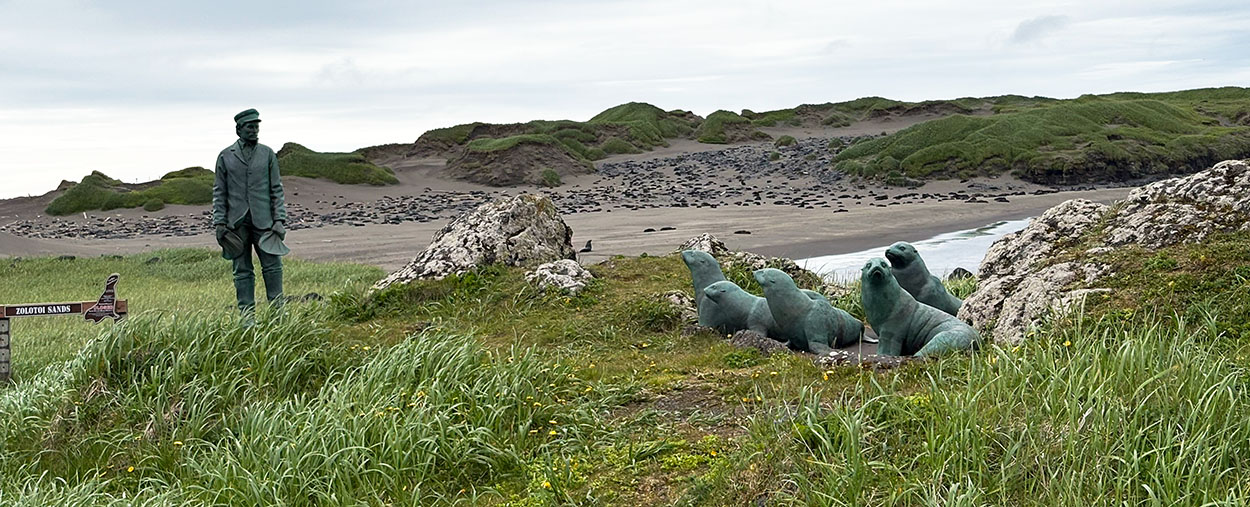
In addition to the birds, Saint Paul Island hosts the world’s largest colony of Northern Fur Seals, which are easily viewed from blinds. In fact, more than 50 percent of the entire population of Northern Fur Seals breeds on the Pribilof Islands. Tourists making the trip to Saint Paul Island to see the Northern Fur Seals are delighted to watch how fun, active, and noisy the animals are, and how they love swimming, fishing, and “waddling” around on the beach, especially during breeding season. They have a lifespan of up to 26 years, and males can be up to 600 pounds, with the females just over 100 pounds.